
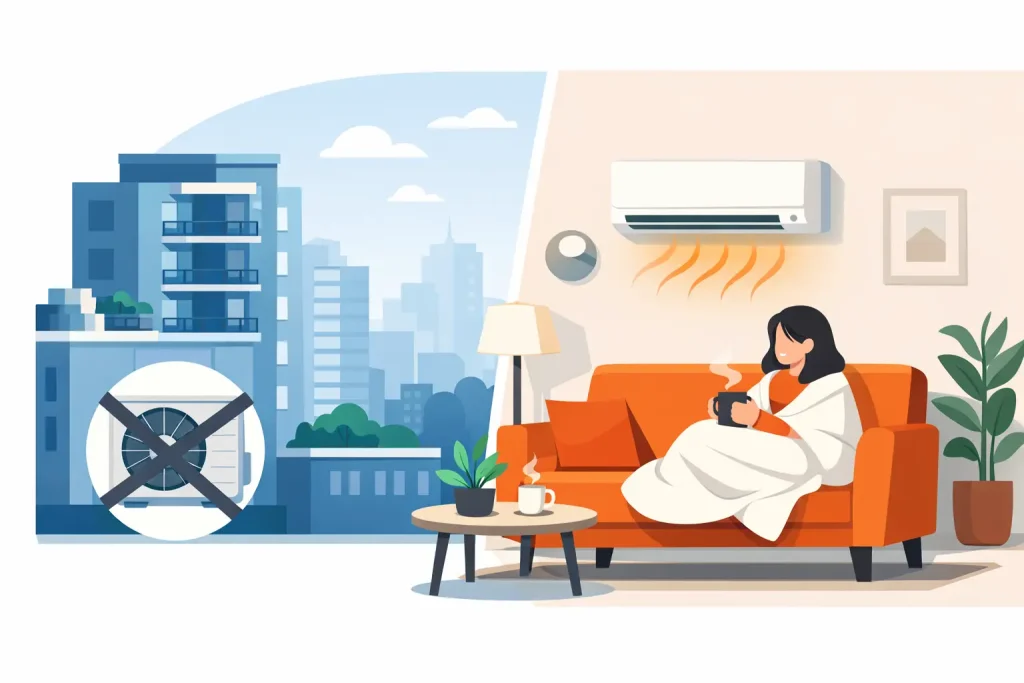
A cold bedroom above a busy street, a living room that overheats in summer but feels draughty in January, and no realistic place for an outdoor condenser: this is a familiar city-flat problem. Learning how to heat city flats starts with the property itself, but it also means choosing a system that respects lease conditions, neighbours, planning constraints and the appearance of the building.
For many urban homes, replacing or supplementing older electric heating with heat pump air conditioning is a practical answer. It can provide controlled warmth in winter and useful cooling when the building holds heat in summer, without the large external box associated with a conventional split system.
Start with how the flat loses heat
Before selecting any heating equipment, establish where the heat is going. City flats vary widely. A newer, well-insulated flat may need only modest top-up heating, while a converted Victorian property with high ceilings, single glazing or an exposed corner position can have a much larger heat demand.
Windows, external walls, ceiling height, insulation, draughts and the number of shared walls all affect the required output. So does the way you use the space. A home office occupied all day needs a different approach from a spare room used only at weekends. In a rented property, simple improvements such as draught sealing, heavy curtains and properly controlled existing heating can make a meaningful difference before any new system is installed.
A professional survey should consider the room size and layout, not simply floor area. Open-plan spaces, mezzanines and rooms with substantial glazing may need careful unit positioning to distribute warmth evenly. An undersized system will run hard without achieving comfort; an oversized one can cost more than necessary and may cycle inefficiently.
How to heat city flats with a heat pump
A heat pump air conditioning unit does not create heat in the same way as a panel heater. It moves available heat energy, which is why it can deliver more heat than the electrical energy it consumes under suitable conditions. For flats using expensive direct electric heating, this can offer a significant efficiency improvement, although actual running costs depend on insulation, electricity tariffs, set temperatures and how the system is used.
The attraction in a city setting is that condenserless heat pump air conditioning avoids a conventional outdoor condenser. Instead, an all-in-one unit is installed within the room. Depending on the model and building, it may use discreet air ducts through an external wall or a water-cooled arrangement connected to suitable building services. This makes it particularly relevant where an external unit would be visually intrusive, difficult to approve or impractical to mount safely.
The same unit can cool in warm weather and heat in colder months. That dual purpose matters in modern flats, where solar gain, cooking and limited ventilation can make summer nights uncomfortable even when winter heating is a priority.
Air-ducted or water-cooled: the right route depends on the building
Air-ducted all-in-one systems are often suitable where a unit can be placed on an external wall and two discreet grilles can be accommodated. There is no external condenser, no exposed refrigerant pipework running down the façade and no need to find space on a balcony or roof.
Water-cooled systems can be an option where external wall penetrations are unsuitable but appropriate water connections are available. The practical details need close assessment, including water supply, drainage, metering, access and any building-management requirements. This is not a decision to make from photographs alone.
Listed buildings, conservation areas and blocks with strict freeholder rules often benefit from early technical advice. A condenserless solution can reduce visual impact, but permissions and lease obligations still apply. A good installation plan addresses these points before work begins, rather than treating them as a last-minute obstacle.
Choose the rooms that will benefit most
It is not always necessary, or sensible, to install heating and cooling in every room at once. For many homeowners, the best starting point is the main living area or the bedroom that becomes intolerable during heatwaves. Landlords may prioritise the room most likely to affect tenant comfort, while office and hotel operators may focus on occupied spaces with poor temperature control.
Room-by-room control is a genuine advantage. You can heat the rooms in use rather than raising the temperature throughout an entire flat. In a two-bedroom property, for example, a unit in the living space may handle evening comfort while a separate bedroom unit provides a quieter, cooler sleeping environment in summer and gentle warmth in winter.
There are limits. If the goal is to replace an entire central heating system across a large or compartmentalised home, the project requires detailed design. Internal doors, hallways and room layout restrict the movement of warm air. Heat pump air conditioning is highly effective for properly sized rooms and zones, but it should not be presented as a one-unit answer for every floorplan.
Installation details matter as much as the unit
The appeal of condenserless systems is not just the absence of an outdoor box. It is the opportunity to keep the finished result tidy. The location of the indoor unit needs to allow good air circulation, straightforward servicing and a sensible route for electrical and condensate work. It should also suit the way the room is furnished, rather than becoming an awkward obstacle above a wardrobe or beside a bed.
In an occupied flat, the quality of the installation experience matters. Residents and neighbours need clear expectations around access, drilling, noise and working hours. Electrical work, plumbing where required, wall making-good, plastering and painting should be planned as one job. Leaving the customer to organise separate trades after the main installation removes much of the convenience that a turnkey service is meant to provide.
Noise is another sensible question. Modern units are designed for occupied rooms, but placement and correct specification are still important, particularly in bedrooms, hotel rooms and care settings. Ask about operating sound levels, night settings and the position of any air grilles. The quietest solution on paper can still disappoint if it is installed in the wrong place.
Use controls to reduce waste, not comfort
A heat pump works best when it is allowed to maintain a steady, sensible temperature. Constantly turning it off and then demanding a rapid recovery can be less efficient than using programmed settings around normal occupancy. That does not mean heating an empty flat all day. It means setting schedules that reflect your routine.
For winter comfort, many people find a moderate target temperature more economical than chasing a very warm room. Lower the setting when sleeping or away, then schedule a return to comfort before you need the room. In summer, close blinds before strong sun reaches the glass and use cooling early enough to prevent the room fabric from storing excessive heat.
Wi-Fi controls can be useful for landlords, second-home owners and busy households, but they are not essential for every user. Straightforward wall controls and a well-explained handover are often more valuable than a complicated app no one uses. The right system is the one residents can operate confidently.
Check permissions, power and ongoing care
Flat heating projects have more stakeholders than a typical house installation. Leaseholders should check their lease and freeholder requirements. Tenants need landlord approval. Property managers may have rules covering façade alterations, drainage, water connections, working hours or contractor access. If the property is listed or in a conservation area, seek guidance before committing to a particular design.
Electrical capacity should also be assessed. A dedicated circuit may be required, and installation must be completed to the relevant standards. This is especially important in older blocks where consumer units and existing circuits may have limited spare capacity.
Once installed, keep filters clean and arrange routine maintenance. A maintained unit performs better, protects air quality and gives small issues a chance to be resolved before they become disruptive. Innovative Air approaches this as an end-to-end project, from survey and specification through installation, finishing work and aftercare, which is particularly valuable when several trades are involved.
The most comfortable city flat is not necessarily the one with the most powerful heater. It is the one with a system sized for the room, installed with care and controlled around real life – giving you warmth in winter, relief in summer and no unwanted condenser dominating the outside of the building.