
A guest who cannot sleep in an overheated room is unlikely to remember the quality of the breakfast. For hotel operators, a hotel air conditioning retrofit is therefore not simply a facilities upgrade. It is a direct investment in reviews, repeat bookings, staff wellbeing and year-round room revenue.
The difficulty is that many hotels were never designed for conventional air conditioning. A listed façade may not permit external condenser units. A city-centre building may have no suitable roof space, restricted access, close neighbours or a layout that makes long runs of refrigerant pipework impractical. Even where a standard split system is technically possible, the visual impact and disruption can make it the wrong answer.
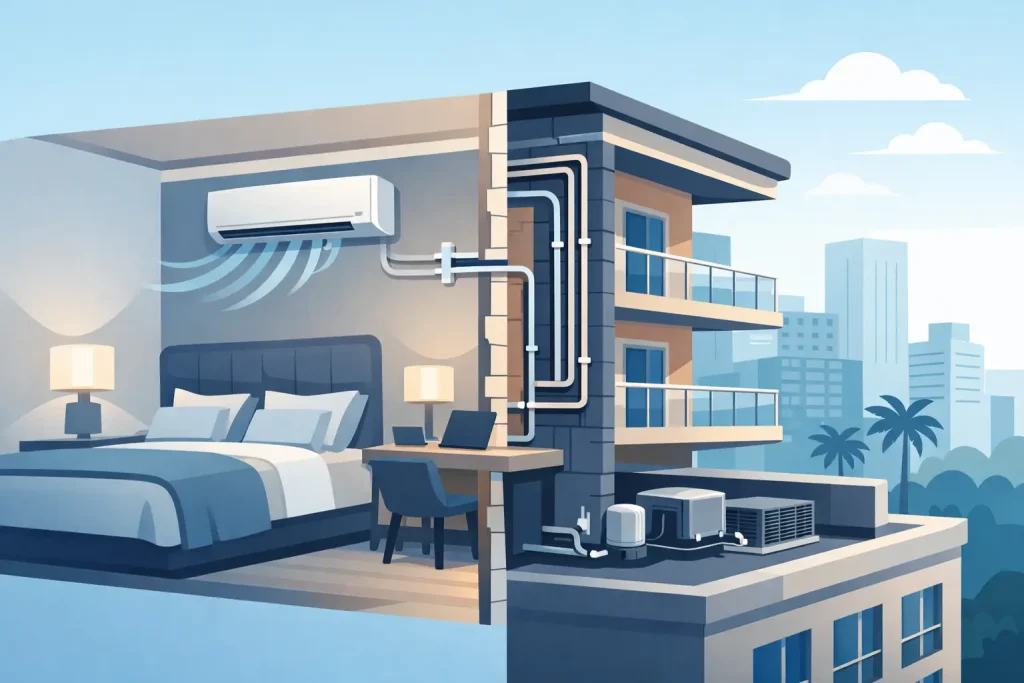
Condenserless air conditioning provides a practical alternative. These all-in-one heat pump units cool and heat rooms without an outdoor box, exposed external pipework or the visual disruption associated with conventional installations. For the right hotel, that can turn a seemingly impossible project into a manageable one.
Why hotels need a different retrofit approach
Hotels have a more demanding brief than most commercial buildings. Bedrooms must be quiet at night, controls need to be simple for guests, and work must be planned around occupancy. The reception area, breakfast room, corridors and back-of-house spaces can all have different heat gains and operating hours.
A successful scheme begins with the individual room, rather than a broad assumption about the whole building. A south-facing top-floor bedroom with large glazing has very different cooling needs from a shaded ground-floor room. Occupancy, window orientation, existing insulation, ventilation, electrical capacity and the building fabric all affect equipment selection.
There is also the issue of guest expectation. Portable fans and temporary units may offer short-term relief, but they add noise, take up floor space and rarely create the calm, controlled environment expected of a quality stay. A permanent system should be discreet, effective and easy for housekeeping and maintenance teams to manage.
Hotel air conditioning retrofit options where condensers are unsuitable
Traditional split air conditioning places a condenser outside and connects it to indoor units with refrigerant pipework. It remains a good solution where external space, planning conditions and installation routes allow. It is not, however, the only route to reliable cooling.
Condenserless systems house the main components within the room unit. Depending on the model and site conditions, they may use discreet air ducts through an external wall or connect to a water circuit. The absence of an outdoor condenser is particularly valuable for hotels in conservation areas, listed buildings, densely built streets and properties where façade appearance matters.
An air-ducted unit can suit bedrooms with an appropriate external-wall position. The installation is compact and avoids siting a condenser on a roof, balcony or rear elevation. Careful positioning helps keep the finished result tidy while allowing the unit to operate correctly.
Water-cooled models can be appropriate where a building has a suitable water supply and drainage arrangement, or where an engineered water loop is viable. These systems require proper plumbing design and consideration of water use, discharge and local requirements, but they can offer a route where external air ducts are not feasible.
The right choice depends on the building, not a preference for one technology over another. A survey should establish whether each guest room can accommodate an all-in-one unit, what routes are available, and whether the expected performance justifies the investment.
Comfort means more than a lower temperature
Cooling capacity is only one part of the specification. In a hotel bedroom, sound levels, airflow direction and control settings can matter just as much. A powerful unit that blows directly onto a bed or operates noticeably through the night can undermine the benefit of cooler air.
Modern heat pump air conditioning can provide both cooling in summer and heating in cooler months. This can be useful in rooms that are difficult to heat evenly, in shoulder seasons when central heating is reduced, or where guests want personal temperature control. It may also reduce reliance on electric panel heaters in selected areas, although the overall heating strategy should always be considered before making assumptions about running costs.
Controls need to be guest-friendly. A clear wall control or simple handset is generally more appropriate than a complex interface with multiple modes. Hotels can also set sensible temperature limits, helping prevent excessive energy use while still giving guests a meaningful degree of comfort.
Noise, drainage and maintenance should be designed in early
Every air conditioning unit produces some operational sound, so selecting the correct model and location is essential. In bedrooms, the priority is quiet night-time operation. In public areas, placement and airflow should avoid creating draughts at tables, reception desks or seating areas.
Condensate drainage is another detail that should never be treated as an afterthought. Cooling removes moisture from the air, and that water needs a safe, reliable drainage route. A proper survey identifies this before installation starts, avoiding awkward surface pipework or last-minute compromises in finished guest areas.
Maintenance also needs to be realistic for a live hotel. Filters need regular attention, and units should be checked to maintain performance and indoor air quality. Selecting equipment that can be serviced without major disruption makes a material difference over its working life.
Planning the installation around hotel operations
The best installations are rarely the fastest-looking ones. They are the ones planned room by room, with access, finishing work and guest impact considered from the start.
A pre-installation survey should assess each proposed location, electrical supply, wall construction, drainage and any listed-building or planning constraints. It should also identify how rooms can be released from service in sensible batches. A phased programme often allows a hotel to retain much of its inventory, rather than closing an entire floor at once.
For occupied properties, cleanliness matters. Bedrooms should be protected before work begins, dust controlled, and all waste removed at the end of each shift. Where electrical alterations, plumbing, plastering and decorating are required, coordinating these trades under one installation plan prevents a room being left unfinished or unavailable longer than necessary.
It is worth agreeing the finish standard in advance. Guests notice trunking, uneven paintwork and poorly positioned controls. A well-executed retrofit should look intentional, not added as a visible remedy after a difficult summer.
How to build a practical business case
A hotel air conditioning retrofit should be evaluated against more than equipment cost. The operational value may include stronger guest feedback during warm weather, fewer room moves, improved comfort for overseas visitors, better staff working conditions and the ability to market cooled rooms with confidence.
Start by identifying the rooms where heat complaints are most frequent. Top floors, south and west elevations, loft conversions, suites with extensive glazing and rooms above kitchens or plant areas are often sensible priorities. Retrofitting the worst-performing rooms first can provide a clearer return than spreading a limited budget thinly across the building.
Energy use should be considered honestly. Air conditioning uses electricity, and the result will depend on unit size, insulation, guest behaviour, control settings and how often doors and windows are left open. Efficient heat pump equipment, sensible set points and clear guest guidance all help. Oversizing is not automatically better: it can increase capital cost and compromise comfort if the unit cycles inefficiently.
For hotels with architectural restrictions, avoiding external condensers can also remove costs and risks that are easy to overlook. There may be no need for roof plant access, structural mounting arrangements, façade alterations or lengthy external pipe routes. That does not make every condenserless option cheaper, but it can make the overall project more straightforward and acceptable.
A specialist survey prevents expensive assumptions
No two hotel buildings present the same challenge. A Victorian townhouse hotel, a converted mill, a coastal guesthouse and a modern city-centre property may all need cooling, but their installation routes and constraints will differ significantly.
That is why a site-specific recommendation matters. Innovative Air specialises in all-in-one heat pump systems where conventional external condensers are unsuitable or undesirable, with installation work managed through to the final finish. The aim is not to force a standard system into an awkward building, but to find a neat, dependable solution that works for guests and the people who run the hotel.
When guests close the door at the end of a warm day, they should notice a comfortable room, not the engineering behind it. That is the standard a well-planned retrofit should meet.