
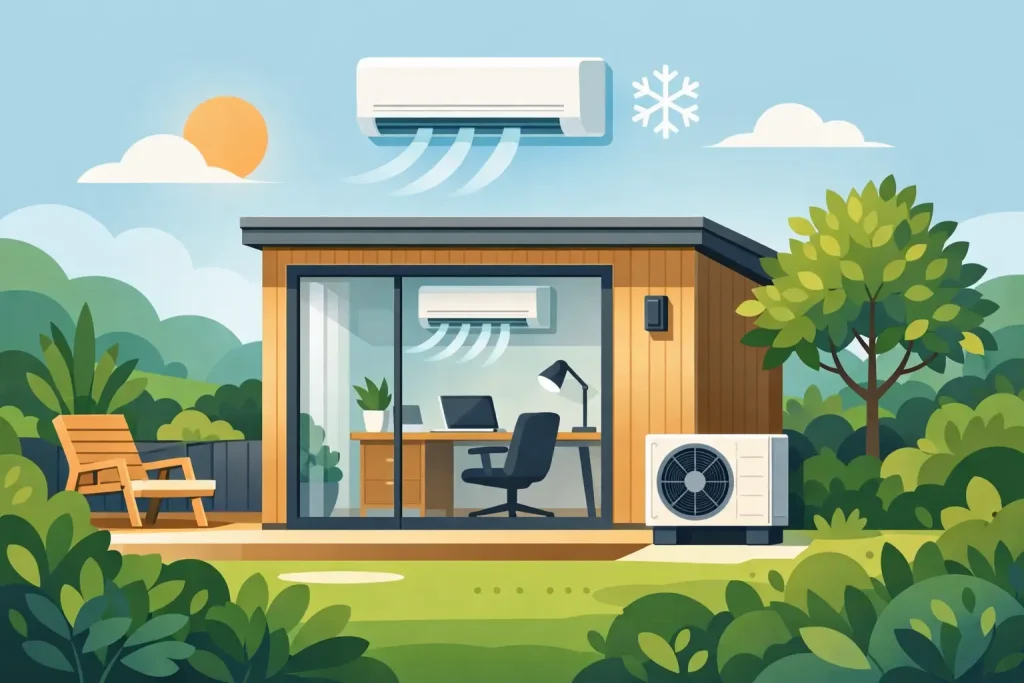
A garden office can feel ideal in April and completely unworkable by July. One spell of direct sun through the glazing, and the room that was meant to help you focus starts feeling stuffy, distracting and far too hot to use properly. That is why air conditioning for garden office spaces is no longer a nice extra for many homeowners – it is what makes the room genuinely usable all year.
The challenge is not simply cooling. Most garden offices need stable temperatures in both directions. They heat up quickly in warm weather, lose warmth fast in winter, and often have more glass, less thermal mass and lighter construction than the main house. If you work there every day, comfort stops being a luxury and becomes part of productivity.
Why garden offices overheat so easily
A garden office is usually compact, well sealed and exposed to direct sunlight for long periods. That sounds efficient on paper, but in practice it can create sharp temperature swings. Solar gain through windows builds up quickly, while computers, monitors, lighting and even one person working in the room add extra heat.
In winter, the opposite problem appears. Small detached buildings can cool down fast overnight, especially if insulation, floor build-up or glazing quality is only average. Portable heaters may take the edge off, but they rarely give you the level of control needed for a proper working environment.
This is where fixed air conditioning starts to make more sense than temporary measures. A good system does not just blast cold air for a few weeks a year. It gives you controlled cooling, efficient heating and a far more consistent room temperature across the seasons.
What to look for in air conditioning for garden office use
The best system for a garden office depends on the size of the room, how often it is occupied, how much glazing it has and whether appearance matters as much as performance. In many cases, appearance matters a great deal. People invest in a garden office because they want a smart, tidy space in the garden, not because they want to look at an outdoor condenser fixed to the exterior.
That is often the point where conventional split systems become less appealing. They can work well, but they rely on an external unit, visible pipework routes and the practicalities that come with those elements. For some garden offices, that is acceptable. For others, it undermines the look of the building or creates planning and positioning concerns.
A condenserless system is often a better fit where you want effective heating and cooling without an outdoor box. These all-in-one heat pump units are designed to sit neatly within the space, avoiding the visual disruption associated with traditional air conditioning layouts. For garden offices in particular, that can be a major advantage.
The case for a condenserless system
If your garden office sits close to a boundary, forms part of a carefully designed garden, or simply needs a cleaner finish, condenserless air conditioning is worth serious consideration. You still get proper climate control, but without an external condenser dominating the outside wall.
That matters for more than aesthetics. External units can affect where you place furniture outside, how the office looks from the house, and how simple the overall installation is. In compact garden settings, every visible element tends to matter more.
A condenserless unit also reduces the sense that you are retrofitting a compromise. Instead, the air conditioning feels integrated into the room. For clients who want a workspace that looks considered and professional, that tidy finish is often part of the decision.
Cooling and heating in one system
Many people start their search in summer, when the office is too hot to use. What they usually end up valuing just as much is winter heating. Heat pump air conditioning is effective because it handles both.
That gives you more than convenience. It can be far more practical than relying on electric panel heaters or underpowered plug-in units. You gain quicker response, better temperature control and a system designed for year-round use rather than seasonal improvisation.
For anyone working regular hours in a garden office, this makes a real difference. A room that is ready at 8 am on a cold January morning is not the same as one that needs an hour of background heating before it becomes tolerable. The same applies in summer when you need the room to remain comfortable through the afternoon rather than peaking at lunchtime and becoming unpleasant by three o’clock.
Installation matters as much as the equipment
Even a well-specified unit can disappoint if it is poorly positioned or badly sized. Garden offices are small enough that airflow, unit placement and heat load calculations have a noticeable impact. Oversize the system and you may end up with inefficient cycling. Undersize it and the room may never feel properly comfortable in peak conditions.
That is why a proper survey matters. The installer should assess room dimensions, insulation levels, glazing, orientation to the sun and how you actually use the space. A garden office used occasionally for admin has different demands from one occupied five days a week with multiple screens, video calls and long working hours.
The finishing work matters too. In a compact office, every detail is visible. Electrical work, making good, decoration and the overall neatness of the installation all affect the final result. A climate control system should improve the room, not leave it looking patched together.
Common concerns from garden office owners
Noise is usually near the top of the list, especially if the space is used for calls, focused desk work or client meetings. That concern is understandable. A unit may perform well on paper, but if it distracts you throughout the day, it is the wrong solution. The answer is not just to ask whether a system is quiet, but whether it is quiet enough for the way you work.
Energy use is another common question. Running costs depend on the unit itself, the insulation standard of the building and how the space is used. But in general, a modern heat pump-based system offers a more efficient way to heat and cool than many standalone electric alternatives. If the office is used frequently, that efficiency becomes more important over time.
People also worry about disruption. That is fair, particularly when the room is already finished and furnished. A specialist installer should be able to explain what is involved clearly, keep works tidy and manage the associated trades so the job does not become a string of separate appointments.
Is a portable air conditioner enough?
For occasional use, some people try a portable unit first. It can seem like the cheaper route, but it often proves frustrating in a garden office. These units are usually noisier, less efficient and reliant on a hose arrangement that is awkward to vent neatly. They also take up floor space in rooms where space is already limited.
There is a place for them as a stopgap, but they are rarely the right long-term answer for a dedicated workspace. If you are using the office properly, day in and day out, fixed air conditioning is a different level of solution.
Choosing a system that suits the building
Not every garden office is the same. Some are premium insulated garden rooms built for daily professional use. Others are converted summer houses or timber structures with more modest thermal performance. The right specification should reflect that reality rather than assume every outbuilding behaves the same way.
This is where specialist advice is useful. A provider focused on condenserless air conditioning can help identify whether an all-in-one heat pump system is suitable, what capacity makes sense, and how to achieve a clean installation without compromising the look of the building. That practical guidance is often what turns a vague idea into a system that works properly.
For homeowners who want a polished result without an outdoor condenser, Innovative Air is one of the few specialists focused entirely on this type of installation. That level of specialisation matters when the brief is not just cooling a room, but doing it neatly, efficiently and with minimal visual impact.
Air conditioning for garden office comfort all year
The best garden office is the one you never have to think about. It is cool when the sun is on the glass, warm when the frost sets in, and comfortable enough that you can get on with your work without adjusting your day around the temperature.
If your current setup relies on opening windows, moving a fan around or switching on a heater an hour before you start, the room is asking for a proper solution. Good air conditioning for garden office use should make the space feel finished – not just in summer, but every working day of the year.
The right system will not shout for attention. It will simply make your garden office feel like a place where work gets done properly.